

Tree Monuments in the Cemetery
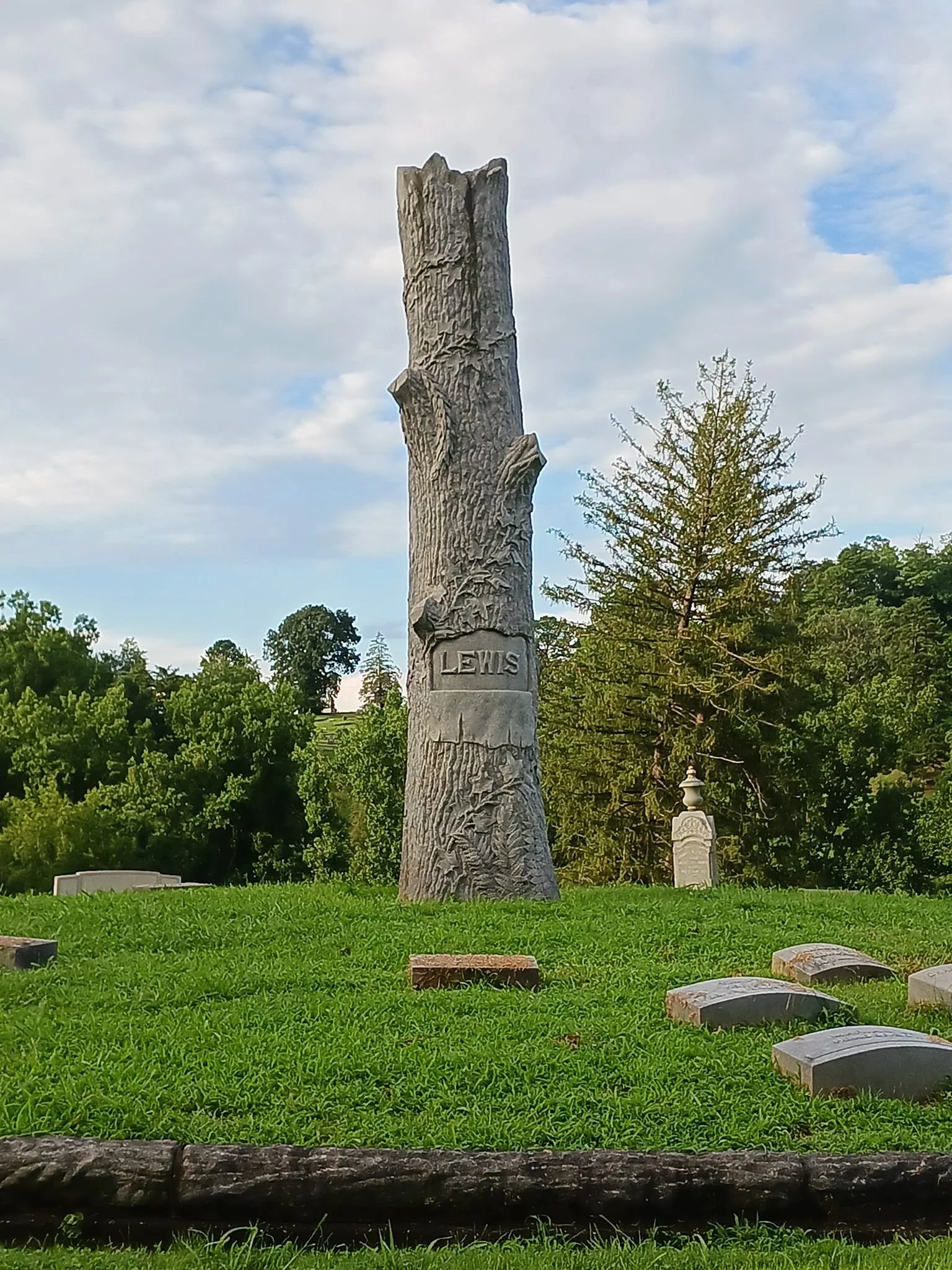
The cemetery is not only home to the living trees of the Mary Price Ratrie Arboretum, but also to a wide array of concrete, cement, and stone grave markers. In funerary art, a tree stump monument can sometimes symbolize a life cut short. In other cases, tree-themed markers were chosen because of a family name or a business connection to wood or forestry. Additionally, many such markers appear in the cemetery because the deceased held a Woodmen of the World insurance policy. Another arboreal touch found throughout the grounds is the use of log borders surrounding family plots.

John Dickinson Lewis (1800–1882)
John Dickinson Lewis was born along the Cowpasture River in Bath County, Virginia, the son of Charles Cameron Lewis and Jane Dickinson. His father died in September 1803 in Point Pleasant. In 1807, his mother married Captain James Wilson, and in 1810 the family moved to the Kanawha Valley, settling in an area known as the Kanawha Salines (Malden). Around 1814, they exchanged property with another longtime resident for the old Fort Lee building in Charleston and relocated there.
Captain Wilson attempted to drill for salt brine on the property but instead struck natural gas, causing an explosion that ended the operation. This event is commemorated today with a marker on the Boulevard. Captain Wilson later represented Charleston in the Virginia Legislature. (Although Captain Wilson is not buried at Spring Hill, Jane Lewis is interred in the Lewis family plot.)
John attended schools in Charleston and Bath County. In 1826, he began his business career as a clerk for Dickinson & Shrewsbury, salt manufacturers. After three years, he became a salesman for another salt producer before opening his own salt manufacturing business in 1831.
John married four times. On November 8, 1826, he married Sallie Lee Shrewsbury, the daughter of his employer. They had one son, Joel Shrewsbury, but Sallie tragically died one month after his birth in May 1830.
In 1831, John married Ann Dickinson, sister of William Dickinson, his first employer. Together they had four children: Sally Jane, Charles Cameron, Mary Dickinson, and William Dickinson, who died in infancy. Ann died in August 1844.
On May 7, 1846, John married Elizabeth “Betsy” (or “Billie”) Darneal. They had two children, Julia Darneal and William Dickinson. Elizabeth died in 1851.
John’s final marriage took place on December 10, 1874, to Sallie J. Gray Spears, a widow with one daughter. The couple had no children together.
As the salt industry declined, census records list John as a farmer and grazier. In 1871, he was elected to the House of Delegates and later served for several years as a justice of the peace.
He was remembered as follows:
“John D. Lewis was a man true to his distinguished ancestry in his private and business life.… He was truly a giant in his day and one of the ‘Salt Kings’ of the olden days, reputed to be the wealthiest man in Kanawha. His character commanded total respect as a man of wonderful energy, the highest probity, and sturdy manliness under all conditions. As the progenitor of a very numerous family, his memory will be recalled with admiration by all his friends and with love by his children’s children for generations to come.”
His large tree stump monument stands atop a small knoll in Historic Section 26, easily visible from Middleton Road.


Woodmen of the World
In 1890, Joseph Cullen Root founded the Woodmen of the World, a fraternal benefit organization created to make life insurance affordable for all. Between 1890 and 1900, membership policies included a tombstone.
For adults, these markers were typically carved to resemble tree stumps, available in a variety of styles and heights. For children, a stack of three logs was common. Members selected their preferred design from those offered by the organization, and plans were sent to a local stonemason near the cemetery where the Woodman would be buried.

Dr. John L. Stump (1852–1916)
Dr. John L. Stump was born in Gilmer County, the son of the Rev. John Stump and Mahala (Huffman) Stump. Rev. Stump (1823–1897) was a well-known Baptist minister for more than forty years and concluded his ministry at West Charleston Baptist Church.
The Stump family had a long association with central West Virginia. Dr. Stump’s great-grandfather, Colonel Michael Stump, was awarded land for his service in the Revolutionary War and fought alongside George Washington at Valley Forge. His grandfather, also named Michael Stump (1787–1884), often recounted stories of hunting with Washington as a young man. He served as a justice of the peace for forty years and as sheriff of Lewis County for six years. The family was of German descent.
Dr. Stump spent his early years in the region before moving to Kanawha County in 1871. In 1876, he began studying medicine under Drs. L. L. Comstock and W. P. Ewing, later attending medical college in Richmond and graduating in 1888. He went on to become a prominent member of the West Virginia Medical Association.
In 1875, he married Ella Copenhaver, and the couple had three children: Charles, Wilber, and Erra D. Ella’s grandfather, Alexander Huffman, represented Gilmer and Calhoun counties in the state legislature.
Dr. Stump tragically lost his life while fighting a forest fire near his winter residence in Florida.
His large tree stump monument, located along Settle Road between the Mausoleum and the Office Administration Building, invariably draws the curiosity of visitors.
Rebecca Tendael Wood Littlepage (1823–1896)
From the West Virginia Star Tribune:
“Mrs. Rebecca T. Littlepage died at 12 o’clock Saturday, after an illness of about ten days, at the old stone mansion near the mouth of the Kanawha, two miles out, which is one of the landmarks of the county and has been the family residence for about fifty years.”
Rebecca was seventy-three years old and was born near the Upper Falls of Coal, the daughter of William Woods, one of the county’s most prominent citizens of his day. She married Adam P. Littlepage, also a leading figure in Kanawha County, who died in 1862. They had seven children—five sons and two daughters—most of whom survived her and were widely respected members of the community.
During the Civil War, Rebecca famously stood on the porch of her home with her children and defied Confederate General Henry A. Wise, who sought to use the house as his headquarters or destroy it. This occurred while her husband was serving in the Confederate Army. Adam Littlepage was reportedly killed in a camp while dueling a man he accused of stealing his horse years earlier. Their son, Adam B. Littlepage, later became a U.S. Congressman.
The family plot features a large acorn monument, symbolizing life, immortality, and the potential strength of the oak. The Littlepage farm also supported a barrel-making business, using oak trees harvested from the property. The family home still stands on West Washington Street and is currently used by the Charleston Housing Authority.
The Littlepage Plot is located on Kinney Drive.